How CRM Software Improves Customer Relationships and Revenue
Most lost sales are not lost to a competitor. They are lost to a reply nobody sent, and nobody noticed for six weeks.
Ask a business owner why they lost a deal and you will usually hear about price or a competitor. Look at the actual record and the answer is more often that somebody meant to follow up on the Tuesday and then the week got away from them.
That is the problem CRM software exists to solve. Not reporting, not dashboards. Making sure the next conversation actually happens.
Where enquiries quietly disappear
Every one of these is ordinary, and every one of them costs money:
- An enquiry lands in a shared inbox and three people each assume someone else replied
- A promising lead goes quiet and nobody notices for six weeks
- Quotes live in one person's sent folder, so nobody else can pick the conversation up
- Nobody can say what is in the pipeline this month without asking around
- Past customers never hear from you again, so repeat business is luck
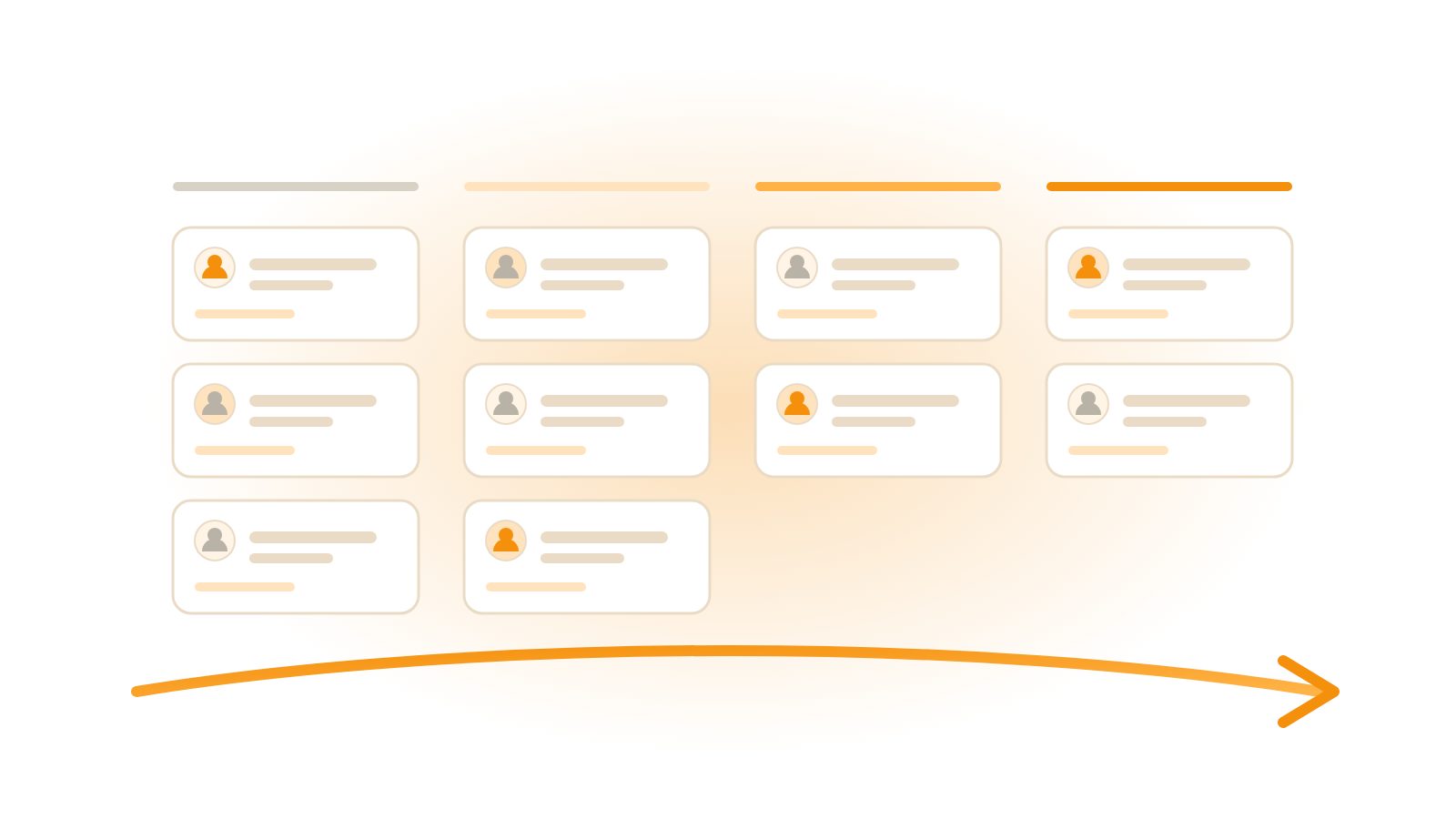
A CRM gives each of those a mechanical answer: one named owner, a scheduled next step, a shared history and one board everyone can see.
What a CRM actually does
Underneath the feature lists, a CRM does four things:
- Captures every enquiry from every channel into one record, automatically where possible
- Assigns each one an owner and a next action with a date
- Remembers the full history: calls, emails, quotes, notes, visible to the whole team
- Shows the pipeline so you can see what is close, what has stalled and what is worth chasing
Everything else — scoring, automation, forecasting — is useful only once those four are reliably true.
Design the pipeline around how you sell
The most common CRM mistake is accepting the default stages that ship with the software. Generic stages produce generic data, and a board nobody trusts gets abandoned within a month.
Your stages should be named in your own words and should represent things that genuinely change. A service business might run:
- New enquiry
- Qualified
- Proposal sent
- Negotiation
- Won
A wholesaler might need three stages plus a samples step. A business with long lead times might need a "nurture" stage so slow deals do not clog the active board. The test is simple: if two people would disagree about which stage a deal is in, the stage is badly defined.
Capture the reason for losing
A mandatory, short list of lost reasons is one of the cheapest sources of insight a business can have. After fifty deals you stop guessing about price and start seeing the pattern.
Integration is where the value compounds
A CRM that sits apart from everything else becomes another thing to update, and people stop. A CRM connected to the tools you already use becomes the place the team works. Worth connecting:
- Your website forms, so enquiries arrive as records rather than emails
- Your inbox and calendar, so conversations and meetings log themselves
- Your store, so purchase history sits on the customer record
- Your accounting tool, so a won deal becomes an invoice without retyping
- Your ERP or stock system, where you have one
Getting a team to actually use it
Most CRM rollouts fail on adoption, not features. What tends to work:
- Make it less work, not more. If logging a call takes longer than making one, it will not happen. Automate capture wherever possible.
- Start with fewer fields. Every mandatory field is a small tax on every record. Add fields only when someone can name the decision the data will inform.
- Have one source of truth. If the real pipeline is still a spreadsheet, the CRM is theatre. Pick one and retire the other.
- Run the sales meeting from the board. Nothing drives adoption like the board being the thing the boss actually looks at.
Off-the-shelf or custom?
Mainstream CRMs are mature and inexpensive to start with, and for most businesses they are the right answer. A custom CRM earns its cost when your sales process is genuinely unusual, when you need it welded to an existing internal system, or when per-seat pricing on a large team has quietly become your biggest software line.
Measuring whether it worked
Pick measures that reflect behaviour rather than activity: how long an enquiry waits for its first reply, what share of open deals have a scheduled next step, how many deals go quiet without anyone noticing. Those numbers move quickly when a CRM is working, and they are the ones that turn into revenue.
The conclusion
A CRM will not make anyone a better salesperson. It will stop good salespeople losing deals to admin, which in most businesses is the larger problem.
Start by writing down what happens between an enquiry arriving and a sale closing. If you cannot describe it in five steps, that is the thing to fix before buying any software at all.
Filed under CRM. More on CRM development and ERP development.